Black Holes may seem mysterious, but they consist of the same ordinary matter that makes up the Sun, the Earth and everything on it. The main difference is that the matter in a black hole is squeezed into an incredibly small volume. If the Earth were to become a black hole, it would have to be compressed to the size of a marble – about 1 centimetre in diameter. Newton’s law of gravitation:
F = G * m1m2/r2
tells us that the attractive force F between two masses m1 and m2 increases as the square of the distance r between the two bodies diminishes. Here on the Earth’s surface we are about 6378 km from the Earth’s centre. On a marble- sized Earth we would only be 0.5 cm from its centre. This huge reduction in r makes the gravitational attraction more than a billion times greater than on Earth normally.
It is this large force that allows a lot of strange things to happen to anything that gets too close to a black hole. For example, there is a point of no return, called “the event horizon”. Once inside, nothing, not even light, can escape. Furthermore, the strong gravitational attraction close to the black hole means that anything moving around it must travel at enormous speeds to avoid spiralling into the hole. If these high velocity pieces of material collide with each other, the collision is disastrous and produces large amounts of heat and light. In this exercise we will learn more about black holes.
The scientist John Wheeler coined the name ‘black hole’ in 1967. It was termed a ‘hole’ because things that pass the event horizon will never re-emerge. In fact, precisely nothing can escape a black hole. Objects can escape from the Earth if they are shot away with speeds larger than 11 km/s. This is a tremendous velocity. But to escape a black hole, an object would need a velocity greater than the speed of light - about 300000 km/s! However, according to the theory of relativity, nothing in Nature can move faster than the speed of light. In other words, not even light escapes: it is truly a ‘black’ hole. So, things disappear inside the black hole never to reappear.
Originally, many scientists considered black holes to be just a nice idea on paper, not something that really existed. Today we have very strong evidence that there is a black hole right at the centre of our own galaxy, the Milky Way. In this exercise we will re-discover this black hole and determine its mass.
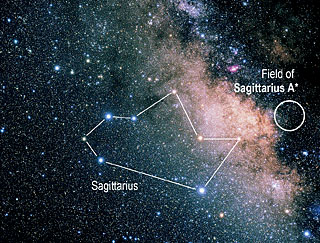
The first hint that there might be a black hole lurking at the centre of the Milky Way came when people noticed a highly unusual source of radio emission in the southern constellation of Sagittarius. This source was named “Sagittarius A*” (SgrA*). It was clear that the unknown source of the radio emission could not possibly be a star and it was speculated that the mystery source might be a black hole at the centre of the Milky Way. Matter circling a black hole at high speed could account for the unusual radio emission signal.
Unfortunately, a black hole is extremely small and completely black so we cannot hope to see it directly. Evidence for a black hole can be obtained by measuring two quantities near the suspected black hole:
The speed tells us about the mass concentrated in that volume of space while the light emitted tells us if this mass could be in the form of stars. There are a lot of stars in motion at the centre of the Milky Way. In this part of the exercise we will use real observations from the centre of the Milky Way to find those stars and measure their speeds.
In the early 1600s Johannes Kepler deduced the
three laws that bear his name and describe the
way planets move around the Sun:
1. Planets move in elliptical orbits around the
Sun. The Sun is at one focal point of the ellipse.
2. The area A crossed by the line joining the Sun
and the moving planet per unit time is a constant
value:
A/Dt = constant
3. The square of the period P of the orbit of the
planet is proportional to the cube of the semi
major axis of the an elliptical orbit (which is half
the distance of the longest axis of an ellipse). It
was later shown that P can be computed from:
P2 = 4p2a3/(G(m1+m2))
where G is the gravitational constant and
m1 the mass of the Sun and m2 the mass of
the planet.