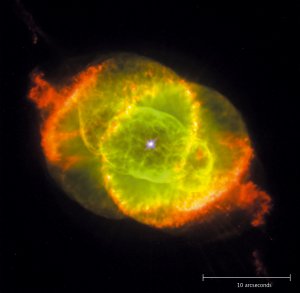
The Cat’s Eye Nebula (NGC 6543) is a so-called planetary nebula. Despite the name, a planetary nebula has nothing to do with a planet. The term was introduced during the 19th century, as these objects looked rather like planets through the small telescopes of the time. Planetary nebulae form during the death throes of low-mass stars, such as the Sun, as the star’s outer layers are slowly ejected.
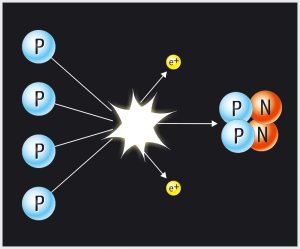
The light emitted by most stars is a by-product of the thermonuclear fusion process known as hydrogen burning, where four hydrogen nuclei fuse into one helium nucleus. Such fusion can only take place at the core of a star where gigantic gravitational forces push the temperatures up to about 107 K. At these high temperatures there is sufficient energy to overcome the electrostatic repulsive forces acting between like-charged protons and so four hydrogen nuclei (protons) can fuse to create a new nucleus, helium (see Fig. 2), and thereby release even more energy.
The mass of a helium nucleus is only 99.3% of the mass of the four original hydrogen nuclei. The fusion process converts the residual 0.7% of mass into an amount of energy — mostly light — that can be calculated from Einstein’s famous equation, E = Mc<. As c2 is a large number, this means that even a small amount of matter can be converted into an awesome amount of energy. The residual 0.7% of the mass of four hydrogen nuclei involved in a single reaction may seem tiny, but when the total number of reactions involved in the fusion process is considered, there is a substantial total mass (and thus energy) involved.

The energy radiated balances the forces of gravitation, and the star remains quietly in a state of stable equilibrium for more than 90% of its life (the Sun should stay in its current stable state for another 5 billion years). When the hydrogen supply in the core of the star is depleted and hydrogen burning is no longer possible, the gravitational forces compress the core of the star. Then the core temperature increases to 100 million K, and the helium nuclei in the core begin to fuse to form heavier elements such as carbon — the process of helium burning. At this time the outer parts of the star swell — for a star the size of our Sun in this phase the outer envelope would extend as far as the current orbit of the Earth.
Material from deep within the star is brought to the surface repeatedly during this late stage of a low-mass star’s life, thereby enriching the outer envelope with elements other than hydrogen, in a process called dredge-up. The envelope is finally ejected out into space, sometimes in a spherical shell, but often in an asymmetrical shape, creating a cocoon around the dying star (see Fig. 4). The ultraviolet light from the central core of the dying star illuminates the expelled material, highlighting the structure of the spectacular planetary nebulae we see in telescopes. Planetary nebulae are very short-lived by astronomical standards. The age of several wellknown planetary nebulae — the Cat’s Eye Nebula (NGC 6543) being one of them — is only around a thousand years, and they are not generally more than fifty thousand years old. After this they slowly fade into the interstellar medium, enriching it with heavy elements available for the next generation of stars.
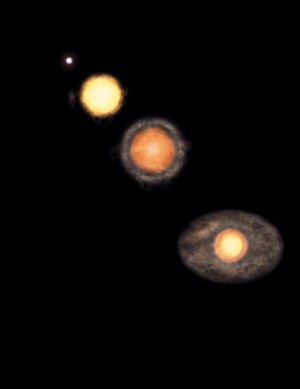
The Sun is an ordinary low-mass star and it will most likely end its life as a spectacular planetary nebula. The Earth will not be able to sustain life when this happens, but we have about 5,000 million years before this becomes our major environmental problem.
In this exercise we will measure the distance to the Cat’s Eye Nebula. The study of physical properties such as the size, mass, brightness and age of planetary nebulae is impossible without accurate distance measurements to the nebulae. Indeed, astronomy in general depends on accurate distance measurements. It is not easy to measure the distances to planetary nebulae. Even though they form from socalled low-mass stars, the initial mass of the progenitor stars can still vary by as much as a factor of ten, giving individual planetary nebulae very different properties. As all planetary nebulae do not have the same size or brightness it is not possible to use such generalisations to estimate their distances. Occasionally, however, observations can be made that allow the determination of the distance to a planetary nebula directly, as is the case with the Cat’s Eye Nebula.
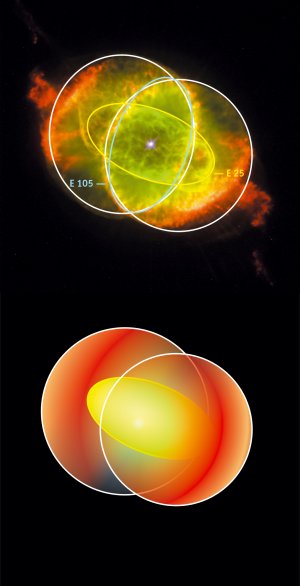
The Cat’s Eye Nebula lies in the constellation of Draco and is one of the most complex planetary nebulae ever seen. Images from Hubble reveal surprisingly intricate structures including concentric gas shells, jets of high-speed gas and unusual knots of gas. It is believed that the central star is actually a double star since the dynamic effects of two stars orbiting each other most easily explain the unusually complex structure of the nebula. Analyses of the different features in the nebula, shown in Fig. 6, have been made several times before. It is known that several of the most prominent features have a different age from the central part of the nebula. The measurements that we make in this exercise will not focus on these features, but on the minor axis of the ellipsoid called E25.